Snoozing is not a rest strategy. Nine minutes is too short to complete a sleep cycle but long enough to start dropping back towards deep sleep, so each subsequent alarm pulls you out of somewhere worse than the last. Four snoozes gets you forty minutes of fragmented, non restorative sleep and four separate doses of grogginess. You would be measurably better off getting up on the first ring.
Knowing that changes nothing, because the decision is not made by the rational version of you. Here are nine things that do change something, roughly in order of how much difference they make.
1. Put the phone somewhere you have to stand up to reach
The oldest advice on the list and still the most effective single change. Once you are vertical and have walked five paces, the physiological state you are in is completely different from the one you were in under the duvet. Standing raises heart rate and blood pressure and starts the process of clearing sleep inertia.
Two things people get wrong. First, across the room is not enough if the room is small. It needs to be far enough that you cannot retrieve it with one foot still in bed. The hallway or the bathroom is better. Second, if you use your phone as a bedtime device, you will resent this and quietly reverse it within a week. Get a cheap wired lamp or a book instead, and let the phone live outside the bedroom permanently.
2. Turn snooze off completely
Not "try not to use it". Remove it. As long as the option exists, a barely conscious brain will take it, and every time it does you are training the habit deeper. The behaviour is repetition driven, and repeated enough it becomes something you perform without ever laying down a memory of it. That is why people genuinely believe they slept through alarms they actually dismissed.
Most alarm apps let you disable snooze. Do that, then set one alarm rather than five. Five alarms is just snooze with extra admin, and it teaches you that the first four are ignorable.
3. Get light on your face in the first ten minutes
Light is the primary signal that stops melatonin production and shifts your body clock earlier. Outdoors is best by a wide margin, because even an overcast morning is far brighter than any indoor room. Ten minutes on a doorstep with a coffee beats an hour under ceiling lights.
In winter, or if you get up before sunrise, a sunrise lamp or any bright lamp positioned where you cannot avoid it is a reasonable substitute. Open the curtains before you go to bed so the room brightens on its own if your sunrise is early enough to help.
4. Fix your total sleep before blaming your willpower
If you are getting six hours, you will snooze, and no technique on this list will hold for more than a fortnight. Sleep debt deepens the sleep you do get, so your alarm is more likely to land in slow wave sleep, which produces the worst grogginess and the strongest urge to snooze.
Work backwards. Fixed wake time, minus eight hours, that is your bedtime, and treat it with the same seriousness as a meeting. The hardest part is not falling asleep. It is stopping the evening ninety minutes earlier than feels fair. There is more on why this dominates everything else in what is actually going on when you cannot wake up.
5. Keep the same wake time seven days a week
Weekend lie ins feel like recovery and behave like jet lag. Shifting your wake time by three hours on a Saturday moves your body clock west, and by Monday morning your body thinks it is 4am when your alarm says 7am.
Within thirty minutes, every day, is the target. If you are short on sleep, go to bed earlier rather than getting up later. A twenty minute nap in the early afternoon costs your night far less than a long morning does.
6. Stop caffeine by early afternoon
Caffeine has a half life of around five to six hours, and a quarter life roughly twice that. A 4pm coffee still has meaningful levels circulating at bedtime. It will often not stop you falling asleep, which is why people insist it does not affect them, but it reduces the proportion of deep sleep you get. You wake unrefreshed, snooze, and reach for coffee to compensate. The loop maintains itself.
A cut off around six to eight hours before bed is a reasonable rule. If that sounds impossible, that is worth noticing in itself.
7. Give the alarm a real dismissal cost
The core problem with a standard alarm is that switching it off is free. One tap, four seconds, back to sleep, no memory of it. Any fix that relies on the alarm being louder is solving the wrong variable.
What you want is an alarm that cannot be dismissed without doing something you physically cannot do while asleep. Puzzle alarms attempt this but you can solve arithmetic lying down in the dark, and you get faster at the puzzles until they become automatic. Shake alarms can be beaten with a limp wrist under the duvet.
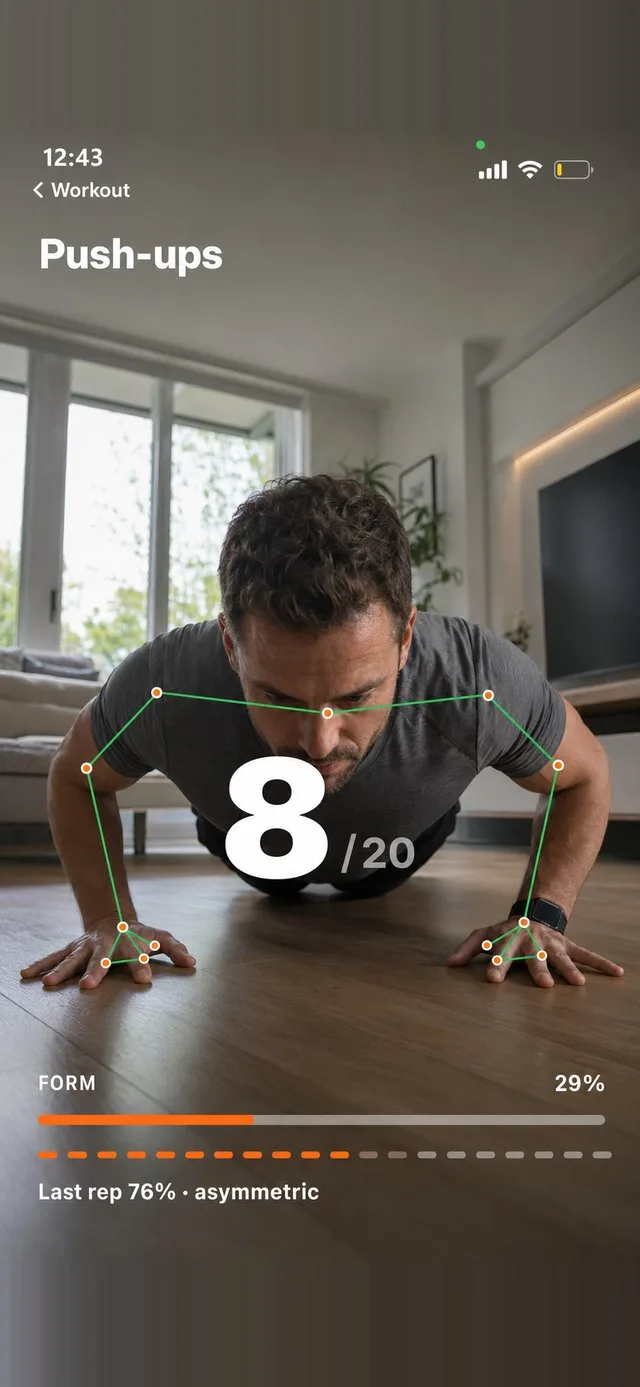
FitClock takes the harder version of this approach: the alarm does not stop until you have completed a set of exercise. The camera uses on device pose detection across 33 body points, so it is watching your body rather than counting phone movement, and every rep is scored for depth, tempo and form. A half squat does not count. There are ten exercises to choose from, including push ups, squats, jumping jacks, lunges, burpees, a plank hold and a simple 50 step walk if you need something quiet, and enabling several gives you a randomised mission each morning so you cannot rehearse your way out of it.
It also rings through Silent mode and Focus, which removes the most common excuse, and an eight week ramp raises your rep target as you get stronger rather than starting you somewhere unrealistic. Nothing is uploaded, there is no account and no analytics, which matters given the camera is pointed at your bedroom.
8. Make the first five minutes require no decisions
Your prefrontal cortex is not fully online when you wake, and that is the part that handles planning and self control. Asking it to choose anything at 6am is asking a system that is not running to perform. So remove the choices in advance.
- Clothes laid out the night before, including shoes.
- Kettle filled, mug out, coffee measured.
- One fixed first action that you never vary, so it becomes automatic rather than chosen.
- No decisions about what to do until you have been up for ten minutes.
The aim is that the path of least resistance leads out of the bedroom. If getting up requires you to think, you will lose.
9. Give yourself a reason to be up
This is the least tactical item and the one that keeps the others alive after week three. If the only thing waiting for you is a commute, your brain will correctly conclude that ten more minutes is the better deal, and it will find a way to get them.
It does not have to be inspiring. Coffee you actually like, twenty minutes of something that is yours before anyone else needs you, a training session, a walk. Streaks help here because they convert an abstract goal into something you can lose, which is a stronger motivator than something you can gain. If the morning training angle appeals but you cannot face it, an alarm that makes you exercise covers how the two problems solve each other.
If none of this works
Give it three weeks. Habits at the boundary of sleep take longer to shift than daytime habits because you are working with limited cognitive resources every single morning.
But if you are genuinely getting eight hours, keeping a fixed schedule, getting light, and still cannot get up or still feel exhausted through the day, stop tuning your alarm. Sleep apnoea, thyroid disorders, anaemia, depression and several other conditions present exactly like this, and none of them respond to discipline. Persistent unexplained exhaustion is worth a doctor's appointment rather than another app.
Remove the easy way out
FitClock keeps ringing until the reps are done properly, so snoozing stops being an option.
Get FitClock