If you sleep through alarms, the problem is almost never that the alarm was too quiet. It is that switching it off costs you nothing. Your half awake brain can reach out, tap a screen and be unconscious again inside four seconds, and it will not remember doing it. Volume is not the variable that matters. Dismissal cost is.
That is the lens worth using when you compare alarm apps. Every app in this category is really making one bet about how to keep you awake for the ninety seconds or so it takes for your brain to come back online. Some bets are better than others, and which one suits you depends on your living situation, your sleep debt and how ruthless you are willing to be with yourself.
Two things an alarm has to do
Arousal is the first job: pulling you out of sleep far enough that you are technically awake. Almost every alarm manages this. The second job is harder. It is keeping you out of sleep long enough that sleep inertia clears and your decision making comes back. During those first minutes your prefrontal cortex is genuinely underperforming, which is why the version of you who turns the alarm off and the version who set it feel like different people.
An alarm that only does the first job is not an alarm for a heavy sleeper. It is a noise.
Loud alarms and gradual wake alarms
These are the standard tools. Escalating volume, harsh tones, vibration, or the opposite approach of a gentle sunrise style fade in over thirty minutes.
They work for people who were already close to waking up. If you sleep seven or eight hours, keep a consistent schedule and mostly wake near the end of a sleep cycle, a decent tone is all you need. Gradual alarms in particular are genuinely pleasant, and if you share a bed with someone on a different schedule they are the polite option.
They fail for the people reading this article, because dismissal cost is zero. Loud alarms also have a nasty second order effect. Being ripped out of deep sleep by something painful produces a stress response, which makes you dread the alarm, which makes you more likely to pre emptively silence it or set five backups you learn to ignore.
Best for: light sleepers, people with a stable schedule, anyone who wakes on the first ring already.
Puzzle and maths alarms
You solve arithmetic, match shapes or retype a string of characters before the alarm stops. The logic is sound: force the prefrontal cortex to do work and it has to switch on.
In practice there are two failure modes. The first is that people get good at the puzzles. Solving three easy sums becomes muscle memory within a fortnight, and muscle memory is exactly what you can do while asleep. The second is that maths is a seated activity. You solve the sums lying down, in the dark, warm, horizontal, and the moment the noise stops every one of those conditions pulls you back under.
They do suit some people. If you find physical tasks impossible first thing, or you have an injury, or you are up in a shared room where any movement wakes someone else, a hard puzzle set is a reasonable compromise. Set the difficulty far higher than feels fair.
Best for: people who cannot or will not move on waking, and who are disciplined enough to keep raising the difficulty.
Shake alarms
Shake the phone a set number of times to dismiss. Cheap to implement, which is why almost every alarm app has one.
The theory is right in that it demands movement. The execution is weak, because a phone cannot tell the difference between you standing up and shaking it and you flapping your wrist under the duvet with your eyes shut. Fifty shakes takes about twenty seconds of lazy motion. You stay horizontal, you stay warm, and you go straight back to sleep.
Best for: a mild nudge on top of another method. Not a solution on its own.
Barcode and QR scan alarms
You scan a barcode you have registered somewhere else in the house, usually the toothpaste or the kettle or a printed code taped to the bathroom mirror. The alarm does not stop until you scan it.
This is a genuinely strong design and it is underrated. It forces the one thing that reliably ends sleep inertia, which is standing up and walking. Once you are vertical and in a lit room, most of the battle is over.
The weaknesses are practical. It depends on a physical object staying where you left it. It relies on the camera focusing, which is unreliable in a dark hallway with a sleepy hand. And it is easy to defeat by simply photographing the barcode and keeping the picture on a second device, which sounds absurd until you do it at 6am. It also does nothing to raise your alertness beyond the walk itself.
Best for: people who live alone, have a fixed morning route, and want out of bed rather than a workout.
Exercise alarms
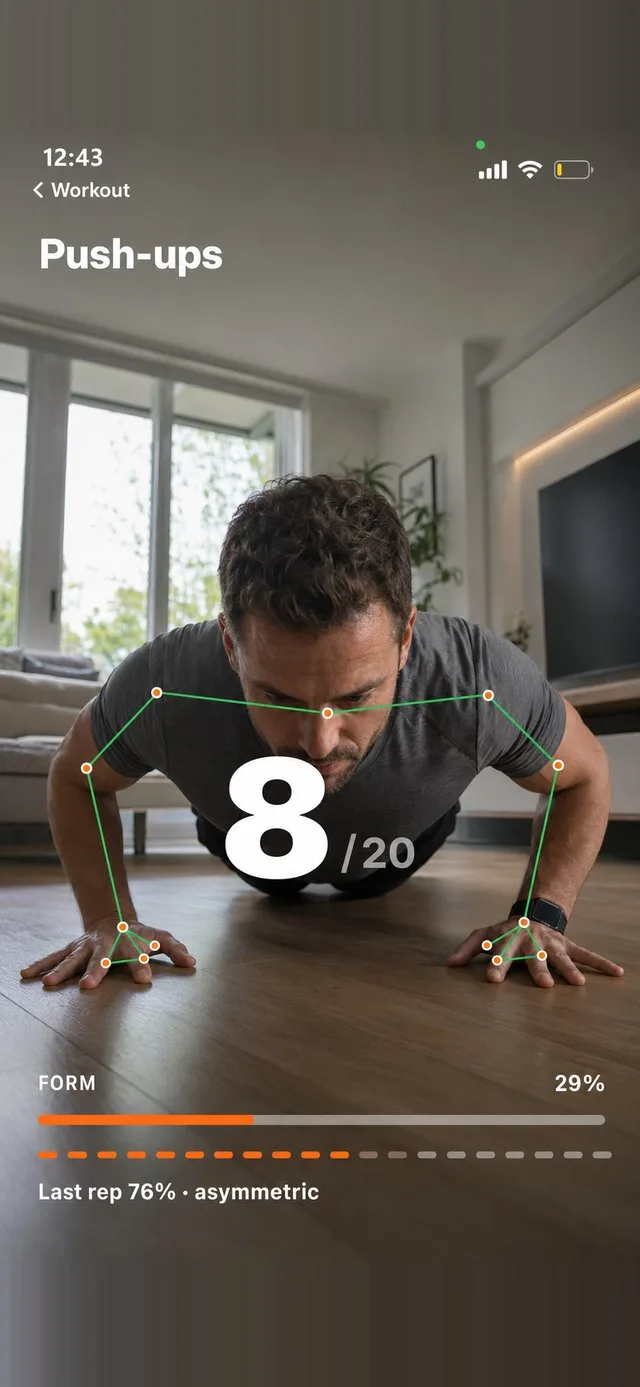
You complete a set of physical reps before the alarm stops. This is the category with the highest dismissal cost, and it is the only one that also raises your heart rate, which is the thing that actually clears sleep inertia rather than just delaying your return to bed.
The category has historically had one big flaw: rep counting was terrible. Accelerometer based counters could be beaten by waving the phone, and early camera counters just watched for any movement. If an exercise alarm can be cheated with a lazy half rep, it degrades into a shake alarm with extra steps.
FitClock was built to close that gap. It uses on device pose detection tracking 33 body points, so it is not counting motion, it is watching your body. Each rep is scored for depth, tempo and form, which means a shallow push up or a squat you barely bend into does not count towards your target. There are ten exercises including push ups, squats, jumping jacks, sit ups, lunges, burpees, mountain climbers, high knees, a plank hold and a simple 50 step walk, and if you enable several the app picks a random mission each morning so you cannot pre plan your way around it.
The other detail that matters for heavy sleepers is that it rings through Silent mode and Focus, so the classic failure of muting your phone the night before and never hearing it does not apply. There is more on that in our piece on getting your iPhone alarm to ring on silent.
Exercise alarms are not for everyone. If you have a joint problem, a heart condition or you are recovering from anything, do not pick a category built on physical exertion without asking a doctor first. If you share a small bedroom, burpees at 6am will not go down well, though a plank hold or 50 steps solves that quietly. And if your real issue is that you are getting five hours of sleep, no alarm design fixes that. Read what is actually going on when you cannot wake up before you blame your willpower.
Best for: heavy sleepers who have tried the easy options, people who want the alarm to also start their training, anyone who snoozes for forty minutes and hates themselves for it.
How to choose
- If you wake up on the first ring most days, stay with a normal alarm. You do not have this problem.
- If you wake but cannot get up, you need dismissal cost. Barcode or exercise.
- If you genuinely do not hear alarms, check that Silent mode and Focus are not suppressing them before you buy anything.
- If you snooze compulsively, remove snooze entirely and pick a method you cannot complete lying down.
- If you are exhausted no matter how much you sleep, that is a medical question, not an app question. See a doctor.
Whichever you choose, the test is simple. Ask yourself whether the you of tomorrow morning, at their laziest and least rational, could defeat it in under ten seconds without leaving the bed. If the answer is yes, pick something harder.
Make getting up cost something
FitClock puts real reps between you and your morning, scored for depth, tempo and form.
Get FitClock